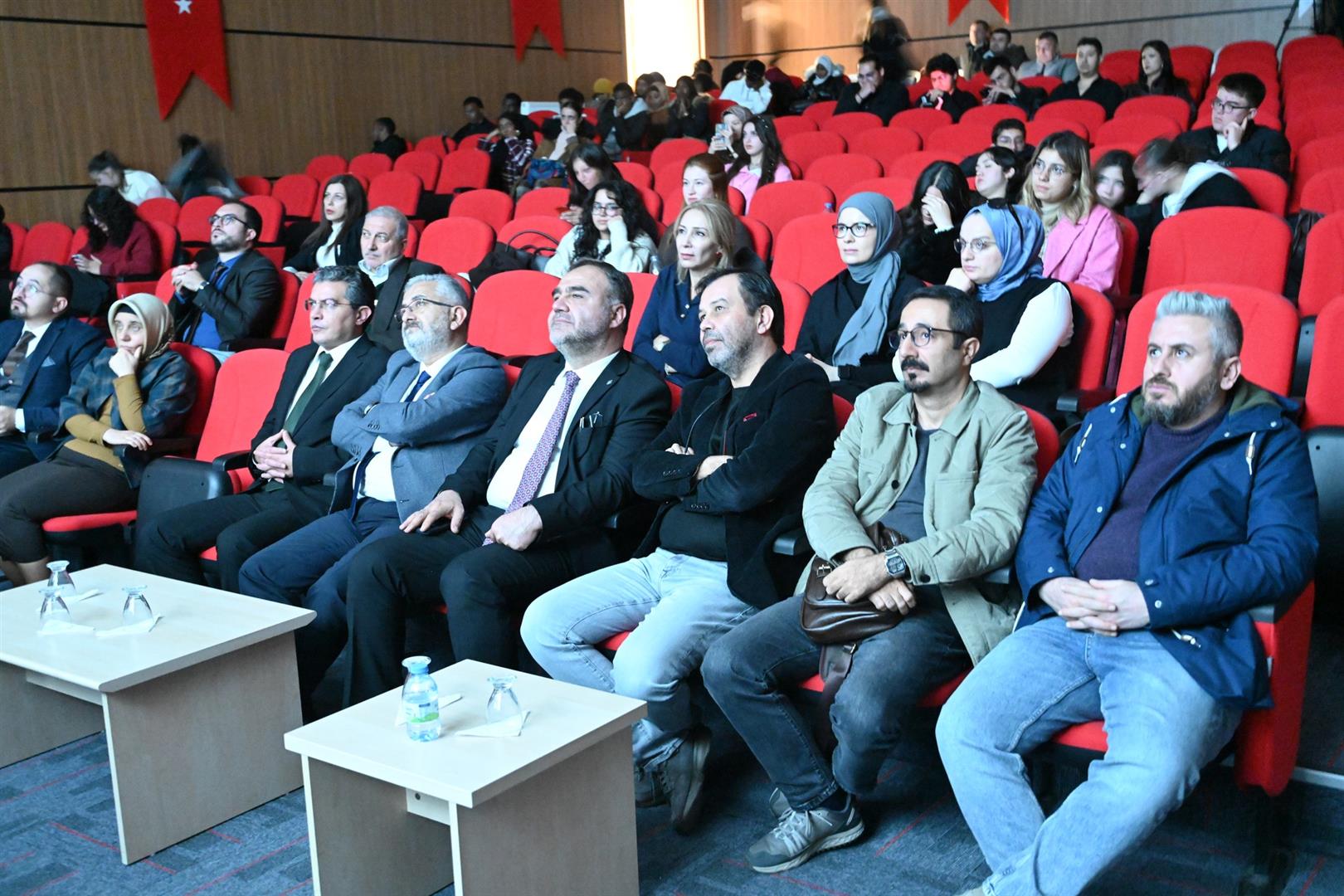
The programme was attended by Rector Prof. Dr. Mevlüt Karataş, Vice Rector Prof. Dr. M. Nuri Öner, Dean of the Faculty of Art, Design and Architecture Prof. Dr. Ersoy Yılmaz, Vice Dean Dr. Rasim Sarıkaya, academic staff from the Department of Cinema and Television, as well as many academics and students from various units of the university. Rector Prof. Dr. Mevlüt Karataş expressed his satisfaction with the students’ sensitivity to the issue and with the films they produced.
Delivering the opening speech, Prof. Dr. Ersoy Yılmaz, Dean of the Faculty of Art, Design and Architecture, underlined that art is not limited to the production of aesthetic forms and stated:
“As a Faculty of Art, our duty is not only to produce aesthetic forms but also to bear witness through art to the pains, injustices and truths of the era we live in. What is happening in Palestine today is not a statistical datum but a test of humanity. Cinema is the strongest medium in this test to make the ‘unseen’ visible and the ‘unheard’ heard.”
Following the opening, a total of seven short films produced by 3rd and 4th year students of the Department of Cinema and Television were screened. These films, which focused on sensitivity to the Palestinian question, the devastating effects of war on civilians, and the themes of justice, human rights and freedom, offered original narratives. The works of the young filmmakers received great interest and appreciation from the audience in terms of both content and cinematic language.
After the student screenings, the internationally acclaimed documentary “5 Broken Cameras”, co-directed by Palestinian filmmaker Emad Burnat and Israeli filmmaker Guy Davidi, was shown. The film portrays the resistance of a Palestinian family living in the West Bank through the breaking of five different cameras and conveys the everyday reality of life under occupation to the audience via testimony and personal memory. The attentive and emotional atmosphere that prevailed in the hall throughout the screening once again revealed the witnessing power of cinema.
Following the documentary, a talk was held with Assoc. Prof. Dr. Tunç Boran, Head of the Department of Cinema and Television, and Lecturer Salih Köse. Moderated by Lecturer Salih Köse, the session offered in-depth evaluations of the film’s cinematographic structure, forms of testimony and the concept of “cinema of resistance.”
Assoc. Prof. Dr. Tunç Boran focused on narrative structures in documentary cinema, providing examples from autobiographical and participatory documentaries. He discussed the increasingly common form of hybrid documentaries in recent years and explained how the boundaries between fiction and documentary have become more permeable. He also addressed the role of Palestinian cinema in bringing the Palestinian cause to the world’s attention, particularly in the context of resistance and the production of collective memory.
Lecturer Salih Köse presented an overview of the historical development of Palestinian cinema up to the present day and touched upon the international awards and visibility achieved by Palestinian filmmakers. He emphasised that Palestinian cinema is not confined to a solely heavy and dark cinematic language, but rather encompasses works produced in various genres and styles. Köse underlined that these films are of great importance in conveying the justice and legitimacy of the Palestinian cause to the entire world.
The event enabled young filmmakers to share their conscientious and questioning perspectives, reminding everyone that cinema, beyond being merely an art form, can become a voice for justice, resistance and humanity. The programme concluded with a group photo and the exchange of good wishes at the end of the talk.
In his closing remarks, Assoc. Prof. Dr. Tunç Boran, Head of the Department of Cinema and Television, thanked all academics, students and especially the student filmmakers who courageously shared their works, and stated that similar initiatives under the theme of “Cinema for Palestine” would continue to be organised in the future.